Physical Address
304 North Cardinal St.
Dorchester Center, MA 02124
Physical Address
304 North Cardinal St.
Dorchester Center, MA 02124

The smartphone is the most personal piece of technology we own. It is our alarm clock, our office, our camera, and our connection to the world. In 2026, choosing between Android (specifically Android 16) and Apple’s iOS 19 is a decision that impacts how you interact with your home, your car, and your work.
In this deep-dive comparison, we break down the key differences in user interface, AI capabilities, security, and hardware to help you find your perfect match.
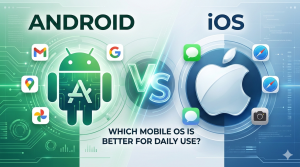
For years, the narrative was simple: Android is for customizers, and iOS is for those who like a set-in-stone, polished look. In 2026, that gap is closing, but the core philosophies remain distinct.
Android 16 introduces the Material 3 Expressive Interface. This system takes Google’s famous “Material You” theming to a new level.3 Not only do your icons and menus change color based on your wallpaper, but the entire OS now adapts its typography and spacing based on your usage patterns.
Lock Screen Widgets: After a long hiatus, lock screen widgets are back and better than ever, allowing you to check transit times or smart home status without unlocking your phone.
Dynamic Multitasking: Android remains the king of productivity. Features like “Split-Screen 2.0” allow you to save app pairs and launch them with a single tap, making it ideal for those who juggle Slack and Excel on the go.
Apple hasn’t sat still. iOS 19 introduces a design language internally known as Liquid Glass. It moves away from flat design toward a more translucent, fluid aesthetic that feels tactile and alive.
The Floating Tab Bar: To make large screens easier to use with one hand, Apple has introduced a pill-shaped floating tab bar that moves to where your thumb naturally rests.
Refined Consistency: Every app on iOS follows a strict design guideline. This means once you learn how to use one app, you effectively know how to use them all. It’s a level of “predictable excellence” that Android manufacturers still struggle to match.
2026 is the year of Agentic AI. Your phone is no longer just a portal to apps; it is a proactive assistant that does work for you.
On Android, Google Gemini 1.5 Turbo is woven into the very fabric of the OS.
Contextual Awareness: Gemini can “see” what is on your screen. If you’re looking at a restaurant menu, you can simply ask, “Is there anything gluten-free here?” and it will highlight the options.
Gemini Live: This allows for real-time, conversational voice interaction that feels human. It can help you brainstorm work projects or even practice a second language while you’re commuting.
Apple’s approach is different. Apple Intelligence focuses on “Personal Context.”
On-Device Processing: Most AI tasks on iOS 19 happen directly on your phone’s NPU (Neural Processing Unit). This means your data—like your emails, texts, and photos—never leaves the device to be processed in the cloud.
Invisible AI: Apple focuses on “invisible” features.9 Instead of a chatbot you talk to, the AI works in the background to summarize long email threads, prioritize your most important notifications, and even “clean up” distracting objects from your photos with a single tap.
The “Apple Ecosystem” is legendary for a reason. If you own a Mac, an iPad, and an Apple Watch, the integration is flawless.
Handoff & Universal Clipboard: Copy a link on your iPhone and paste it directly onto your Mac.
AirDrop: Still the gold standard for sending high-resolution videos and files to friends and colleagues instantly.
iMessage & FaceTime: These remain powerful social anchors, especially in North America, where blue bubbles often dictate social circles.
Android doesn’t trap you. It is built on the idea of Cross-Platform Flexibility.
Google Workspace Integration: If your life runs on Gmail, Google Drive, and Google Calendar, Android is your native home.
Device Variety: You aren’t limited to one manufacturer. You can use a Samsung phone, a Sony camera, and a Windows PC, and they will all talk to each other through open standards like Matter (for smart homes) and Link to Windows.
In an era of increasing digital threats, security is a top priority for daily users.
iOS 19 continues Apple’s “Privacy as a Human Right” mission. Features like App Tracking Transparency and Private Cloud Compute ensure that even when the cloud is used for AI, your data is cryptographically locked away from Apple themselves.
Android 16 has made massive strides with the Security Hub. It uses AI-driven “Real-time Fraud Detection” to scan incoming calls and messages for scam patterns, warning you before you even pick up the phone. Android’s “App Sandbox” also ensures that even if you download a malicious app, it cannot access your sensitive system files.
To truly experience these operating systems, you need the hardware that was built to showcase them.
The iPhone 16 Pro Max is the current gold standard for the iOS experience. With the A18 Pro chip, it handles “Apple Intelligence” with ease and features a stunning titanium build.
Why we love it: The camera system is unrivaled for video creators, and the battery life consistently lasts through two days of moderate use.
Check Price on Amazon.com – Apple iPhone 16 Pro Max
Freshly released in early 2026, the Galaxy S26 Ultra is the ultimate “everything” phone. It combines the power of Android 16 with Samsung’s legendary “One UI 8” and a built-in S-Pen.
Why we love it: The 200MP camera and 100x Space Zoom make it a photographer’s dream, while the massive QHD+ screen is the best display ever put on a smartphone.
Check Price on Amazon.com – Samsung Galaxy S25 Ultra
| Feature | Android 16 | iOS 19 |
| Customization | High (Launchers, Widgets, Themes) | Moderate (Lock screen & Home screen) |
| AI Integration | Google Gemini (Powerful, Multimodal) | Apple Intelligence (Private, Contextual) |
| App Store | Google Play (4M+ Apps, Flexible) | App Store (2M+ Apps, Highly Curated) |
| Security | AI Fraud Detection & Sandboxing | Privacy-first, On-device encryption |
| Updates | Varies by manufacturer (7 years for Pixel/Samsung) | Immediate & Universal (5-7 years) |
| Hardware Choice | Hundreds of options (Foldables, Rugged, Budget) | Limited (iPhone only) |
The “better” OS is the one that fits your lifestyle.
Choose iOS if:
You already own other Apple products (Mac, iPad, Apple Watch).
You prioritize privacy and want a “set it and forget it” experience.
You want the highest resale value for your device 2–3 years down the line.
Social features like iMessage and high-quality social media app optimization are vital to you.
Choose Android if:
You love technology and want to “tinker” with your phone’s look and feel.
You need the best multitasking tools for work and productivity.
You want cutting-edge hardware features like folding screens or insane zoom cameras.
You are a heavy user of Google’s suite of tools (Gemini, Drive, Photos).
In 2026, you truly can’t go wrong with either. Both platforms offer a world-class experience that would have seemed like science fiction just a few years ago.


